
When Adam Fox went down with an upper body injury, the Rangers were going to have to make adjustments to be able to drive offense without their best puck mover and overall best player on the ice. Rangers breakouts are mostly simple, with or without Adam Fox, and the adjustments made aren’t necessarily at a systemic level, more at a support level. What has changed with the Rangers breakouts is about forward positioning and first pass location. They are two small changes made to get more out of a defense group that struggles to move the puck, and it’s been working thus far.
Rangers breakouts aren’t fancy
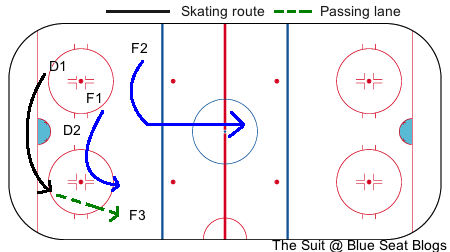
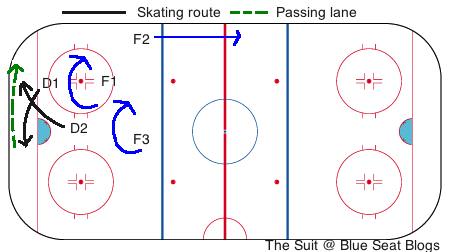
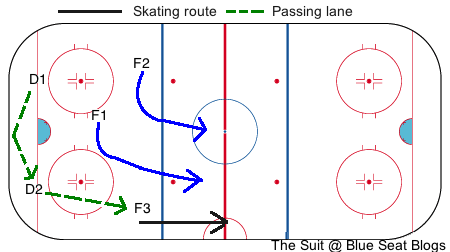
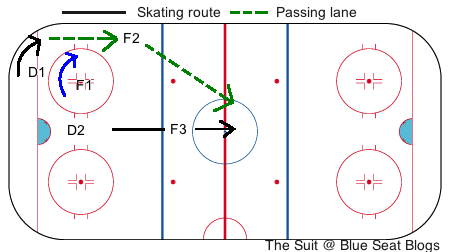
Most teams run the same four breakouts: wheel, reverse, over, and quick up. All four rely on quick passing to break the forecheck and move the puck up the ice. Naturally, the Rangers couldn’t execute these consistently without Fox on the ice. So when he went down long term, changes had to be made. In fact, changes had to be made regardless, as only Fox had the skill set needed to make quick decisions with the puck on Rangers breakouts.
The common theme is that F1 is no lower than the hashes and F2 is rarely below the tops of the circles. Teams with strong puck movers on the blue line are fine, but most teams need to make adjustments. The Rangers breakouts are no different.
Two small adjustments, instead of one big adjustment
Where the Rangers breakouts changed is in both forward positioning and first pass location. Watching last night’s Ottawa game, we can see F1 is routinely at the hashes and F2 is lower in the zone, creating shorter passes to break the forecheck.
It’s a small adjustment, bringing the forwards in more, but it helps with giving the defense more support to skate the puck up and make a better, crisper first pass.
That is the second adjustment: Defense skating the puck up a bit more instead of looking to make that first pass from the goal line. If we watch the horrific loss to the Lightning, we see more passes and turnovers originating from behind the net.
When the Rangers are stagnant and looking to create from behind their own net, they are going to get crushed. They simply don’t have the personnel to make that work. But when Rangers breakouts are a bit more fine tuned to the roster, creating from more support low and easier decision maker, they become more than the sum of their parts, a term we’ve said a lot on Live From the Blue Seats.
Naturally there is a small sample size warning here. It’s only two games with the Rangers breakouts looking crisper without Adam Fox. They could fall back into old habits quickly, but Mike Sullivan is not that kind of coach. This is why Sully was hired – to make these adjustments to help the roster grow and get the most out of what is essentially an aging core up front and a somewhat one-dimensional blue line.
So far, the changes to the Rangers breakouts are paying dividends. When Fox returns, we should expect the Rangers to give him a bit more freedom with the puck on breakouts. But don’t miss the forest for the trees. The real win is finding a way to get the puck up the ice without Fox. Even when he’s healthy, there’s still 40 minutes that he’s not out there. The Rangers need to make this work for all 60 minutes of a game, so even when Fox returns, we should still see these adjustments in place.
More About: Hockey Tactics